

In our recent roadshow we encountered rising fears over inflation and bond yields, more nuanced prospects for politics and reform in Latin America and, for markets, a whole lot of nothing out of the China-US summit.
Investors we visited in the UK and Europe stroke a more cautious tone for global markets and risk, marking a shift from the generalized optimism prevalent since the late-March bullish inflection. Three subjects caught our eye, starting with renewed focus on inflation risks rather than on growth. Second, we found eroding conviction about Latin America’s rightward political change1. Last, we caught some degree of disappointment at the China-US summit yielding no positive catalyst. Below are more details on these three observations:
A trickier inflation-growth tradeoff
Concerns over risks of sticky inflation came up in every conversation, not surprisingly after the recent jump in global long-term yields which in some cases topped their 2022 highs2. While there is widespread recognition that risks are likely to mount the longer the Strait of Hurmuz stays closed, the hawkish repricing for policy rates has gone a long way already3. For example, we heard a lot of pushback against market pricing for a rate hike in early 2027 in the US.
Turning to emerging markets, for the most part investors saw a high bar for rate hikes outside a handful of cases, mostly in Asian countries where the negative terms-of-trade shock is leading to currency weakness (such as Indonesia4). In Latin America, where the starting point for nominal and real rates is higher, the talk was more about the energy shock acting as a constraint on further easing rather than forcing central banks to tighten. That means exposure to local rates in the region remains compelling, with gains likely to come mostly from carry and not from currency strength or tighter spreads.
For stocks, earnings optimism – above all from the US and, in EM, centered on tech and materials – was moderated by tactical caution from rising cost pressures and interest rates5. While the bias remained bullish due to earnings momentum and less demanding multiples, the path forward is likely to be trickier. The reason is that resilient growth is compounding energy-linked inflation concerns – which is why, like in the 2022 episode, stocks and bonds are trading in tandem, making stocks more responsive to changes in yields6 (see Figure 1).
One takeaway from both stock and bond investors was a greater emphasis on differentiation, whether along relative beneficiaries of terms of trade, the AI buildup or companies deriving operational efficiencies from AI. While portfolios exposed to these themes have done well so far this year, they still saw room for additional outperformance.
Conservative tide or else?
The expectation of a rightward political shift is a long-standing bullish argument in favor of exposure to Latin America, along with leverage to commodities and high real rates. After a series of victories by the right (Argentina, Chile7) boosted optimism about more business-friendly policies, the path forward looks more uncertain – in part reflecting markets’ underestimating incumbents’ willingness to use aggressive fiscal moves to sway voters (like Colombia’s 23% minimum wage hike8).
Figure 1: Global stocks and bonds are moving in tandem (correlation of bond and stock returns, 1-month rolling, 3-day moving average)
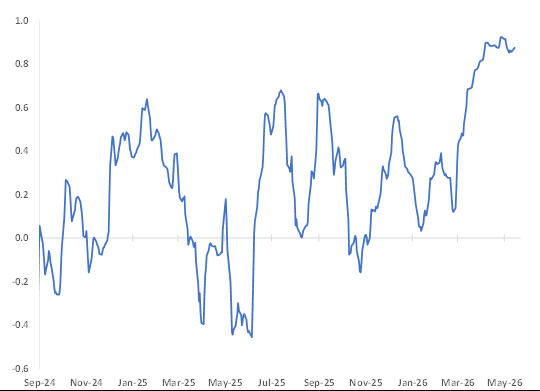
Source: Bloomberg, MSCI. TRG calculations Data as of May 20, 2026*
Incoming polls suggest Peru may join the rightward shift9. The center-right candidate’s party has enough senate seats to block any impeachment effort, a plus for governability. Colombia’s, where fiscal fragilities persist, faces a highly uncertain election, irrespective of which of the two main opposition candidates earns a spot in the June 21 runoff10. Brazil’s race is also shaping out to be a contested one, with poll results and corruption scandals already generating a fair amount of volatility more than four months before the vote11. The electoral uncertainty makes positioning more challenging; in general, interest rate trades in Brazil and Colombia seem to offer better risk reward, whereas currency trades and stocks – which held up relatively well during the risk-off phase in February – seemed more symmetric.
China-US: more talks, little else
The China-US summit failed to become a tradable event. In fact, divergent readouts from both sides suggest little tangible progress on key areas such as trade, cross-border investment, Iran or Taiwan12. Investors thought that the main result was that the bilateral relationship stays stable for now – meaning status quo – with plans meet again raising the hurdle for escalation.
The summit leaves China relaying on its tech-and-export centric growth model, without urgency to rebalance. In turn, in some talks we heard that this “China shock 2.0” will become tradable at some point by narrowing the space for other countries to industrialize, with negative implications for growth and stability.
ABOUT TRG
Founded in 2002, The Rohatyn Group (TRG) is a global asset manager focused on emerging markets and real assets. Headquartered in New York the firm is comprised of ~100 professionals based in 14 countries across North and South America, Europe, the Middle East, Africa, India, Southeast Asia, and Oceania.
TRG investment capabilities span private and public asset classes focused on emerging markets as well of global forestry and agriculture investments. At the core of our business, we are dedicated to providing specialized investment solutions. Leveraging our global-meets-local approach, on-the-ground coverage, and extensive multidisciplinary investing experience we work strategically to address our clients’ unique needs.
Learn more at: https://www.rohatyngroup.com/
IMPORTANT INFORMATION – REFERENCES
1 Americas Quarterly. (2025, May 13). Latin America’s Rightward Shift.
2 Bloomberg. (2026, May 18). Bond Rout Deepens as Rising Oil Prices Stoke Inflation Fears.
3 J.P.Morgan Private Bank. (2026, March 27). The Global Rates Repricing: Will Central Banks Actually Hike?
4 Wall Street Journal. (2026, May 20). Bank Indonesia Delivers First Rate Hike in Years as Rupiah Flounders, Risks Rise.
5 MarketWatch. (2026, May 5). This is Why Stocks Keep Rallying, According to Morgan Stanley.
6 Russell Investments Research. (2025, June 16). They Move in Mysterious Ways – Stocks vs. Bonds.
7 BBC. (2025, October 27). Javier Milei and his “chainsaw” austerity win big and Americas Quarterly. (2025, December 15). What Kast’s Victory Means for Chile.
8 FitchRatings. (2025, January 8). Colombia’s Minimum Wage Hike Adds to Macroeconomic Pressures.
9 Reuters. (2025, May 20). Right wing Fujimori holds narrow lead over Sanchez in Peru election poll.
10 Americas Quarterly. (2026, May 15). Colombia’s 2026 Presidential Candidates: Cepeda, de la Espriella, and Valencia.
11 The Economist. (2026, May 14). A bombshell leak threatens Flavio Bolsonaro’s election bid.
12 Semafor. (2026, May 14). Opposing US-China readouts expose diplomatic fault lines.
* Rolling correlation between MSCI ACWI, Mid & Large Cap, Total Return in USD and the Bloomberg Global Aggregate Government Index, Total Return in USD
IMPORTANT INFORMATION – DISCLAIMERS
The information provided herein is for educational and informational purposes only, and neither The Rohatyn Group nor any of its affiliates (together, “TRG”) is offering any product or service hereby. The information provided herein is not a recommendation, offer, or solicitation of an offer to buy or sell any security, commodity, or derivative, nor is it a recommendation to adopt any investment strategy or otherwise to be construed as investment advice. Any projections, market outlooks, investment outlooks or estimates included herein are forward-looking statements, are based upon certain assumptions, and should not be construed as an indication that certain circumstances or events will actually occur. Other circumstances or events that were not anticipated or considered may occur and may lead to materially different outcomes. The information provided herein should not be used as the basis for making any investment decision.
Unless otherwise noted, the views expressed in the content herein reflect those of the authors set forth and are not necessarily the views of TRG. In fact, the views of TRG (and other asset managers) may diverge significantly from certain of the views expressed in the content herein. The views expressed in the content herein are subject to change without notice, and TRG disclaims any responsibility to furnish updated information in the event of any such change in views. Certain information contained herein has been obtained from third-party sources. While TRG deems such sources to be reliable, TRG cannot and does not warrant the information to be accurate, complete or timely, and TRG disclaims any responsibility for any loss or damage arising from reliance upon such third-party information or any other content provided herein.
Exposure to emerging markets generally entails greater risks and higher volatility than exposure to well-developed markets, including significant legal, economic and political risks. The prices of emerging market exchange rates, securities and other assets are often highly volatile and movements in such prices are influenced by, among other things, interest rates, changing market supply and demand, external market forces (particularly in relation to major trading partners), trade, fiscal and monetary programs, policies of governments and international political and economic events and policies. All investments entail risks, including possible loss of principal. Past performance is not necessarily indicative of future performance.
The information provided herein is neither tax nor legal advice. You must consult with your own tax and legal advisors regarding your particular circumstance.