

Recent EM stock volatility spiked to levels often associated with stress. With some drivers of this uncertainty unresolved, the case for an approach to EM that looks beyond the major index is becoming more compelling.
For EM stock investors, it’s been a summer of sharp gyrations. The unwind in the AI-centric momentum trade – the most severe outside the initial pandemic drawdown – dragged the EM benchmark to a three-month low, down -13% from its late-June peak. Then on the last trading day of July, EM stocks jumped nearly 7%, the largest single-day gain since 2008. The winners of the first half, tech and industrials, saw double-digit corrections; by contrast, out-of-favor sectors like health care and consumer discretionary outperformed by a wide margin.
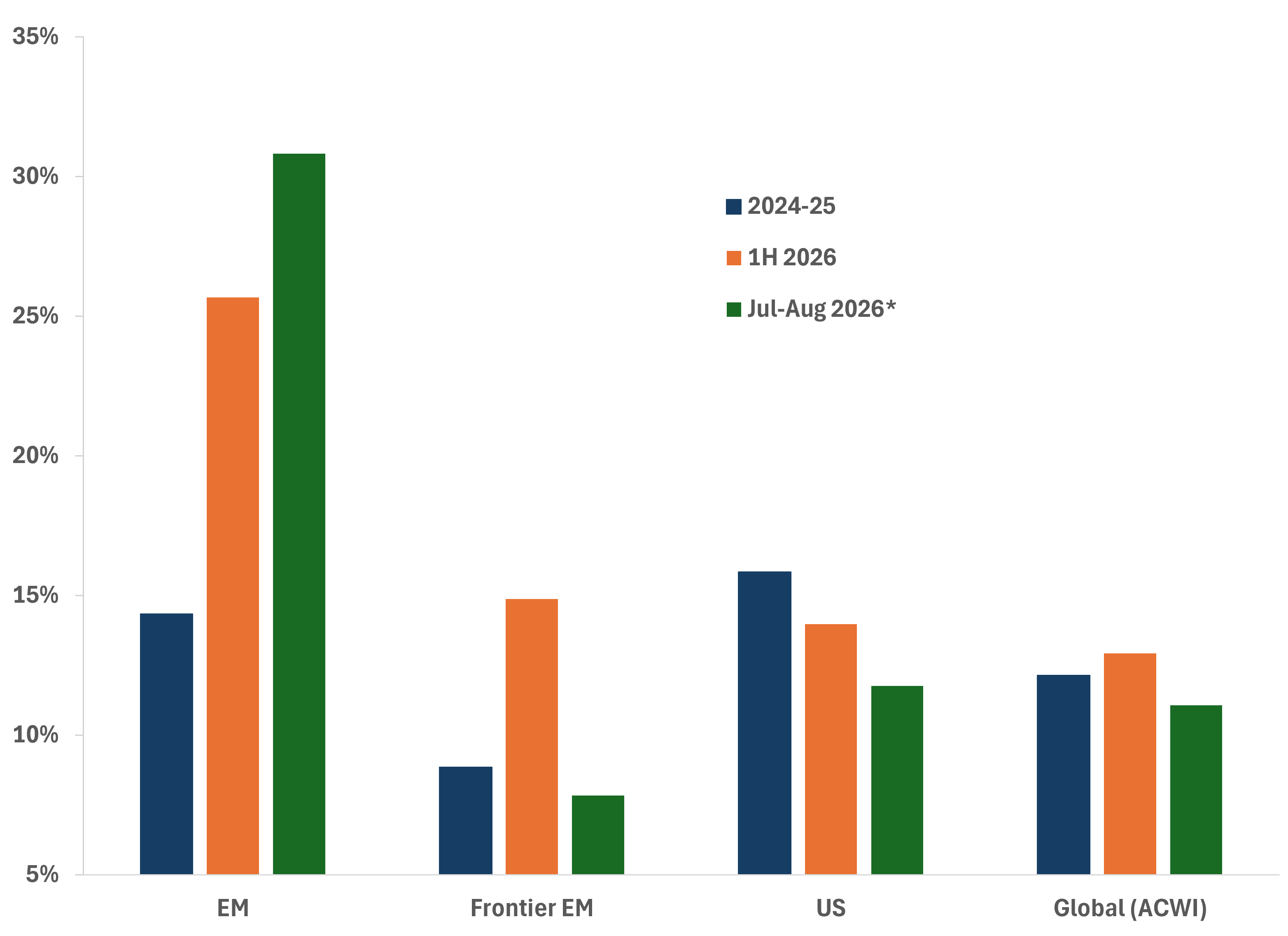
Along with large sector rotations and big single-name moves came a surge in EM index-level volatility, which spiked to 31% annualized since July – a level often associated with periods of stress. And that jump came off an already high base: first-half volatility was 26%, far above the 14% average from 2024-25 (see Figure 1). The recent jump in EM volatility contrasts with contained levels seen in US, global and frontier benchmarks. The good news is that progress with deleveraging means the EM momentum unwind is behind; for example, in tech-heavy Korea regulatory measures (along with poor price action) caused levered ETF assets and margin loans to plunge1,2.
Figure 1: EM stock volatility surged in July, bucking the moderating global trend (standard deviation of daily returns, % annualized**)
Yet the underlying causes of the rise in EM volatility, which we argue originate mainly from the rapid pace of technological innovation and geopolitical disruption, remain very much in play, in our view3,4. Navigating this complex backdrop, we think, requires keeping a close eye on three fronts:
AI narrative. The AI capex story remains intact with hyperscalers recently raising or affirming guidance5. Markets, however, are becoming increasingly discerning about AI-capex monetization and discipline, funding sustainability, China competition and related topics– issues that won’t be resolved anytime soon6. Firms taking part in the AI buildup, including many in EM, keep benefiting – strong revenues and earnings indicate as much – but investors have moved past the point of indiscriminately rewarding them and the earnings bar is higher.
Federal Reserve path. The new leadership’s plan to scrap forward guidance has its merits, including greater flexibility by being less bound to prior projections and prompting markets to more closely evaluate implications of economic data7. No forward guidance combined with a lack of clarity about the reaction function, however, is leading to bond-market volatility and higher back-end yields as investors adjust to this transition (and many question the Fed’s inflation-fighting commitment8). Uncertainty about the Fed’s path could add to yield pressures from concerns over fiscal sustainability and heavy issuance.
War and energy. The Middle East conflict remains unresolved, caught in an on-and-off cycle of contained fighting. Both oil prices and crack spreads remain above levels seen during the ceasefire, as is crude volatility. While stocks seem to be looking past the bulk of this noise, risks of higher energy prices – with implications for inflation and growth, monetary policy and long-end yields – persist at a time of diminishing inventory cushion9.
This year’s above-average volatility in EM creates a challenge for investors seeking to maintain or increase allocations. In other words, the challenge is about generating compelling risk-adjusted returns at a time when a strong earnings outlook supports the case for holding equities – the EM index rose 21% through mid-August with improving earnings prospects doing all the heavy lifting (see “Letter from New York: Transitioning to a Healthier EM Dynamic,” February 26, 2026).
One potential route that could have mitigated the volatility challenge involved building portfolios with exposure beyond the major EM index. After all, the EM benchmark today overexposes investors to a single thematic because its structure resembles a proxy for the AI buildup (the IT sector was 41% of the index in July, and the three big semiconductor makers 28%). Looking back over 1-to-3-year horizons, for example, a balanced strategy of holding equal weights in EM and frontier indices cut portfolio volatility by roughly 30% while yielding comparable returns, based on our calculations10.
Shifts in country and sector leadership, along with changing correlations and wide valuation gaps are creating a broader opportunity set in the EM equity space. The momentum unwind exacerbated volatility in EM of late, yet the nature of the core drivers of uncertainty – rapid technological, geopolitical and policy changes and their consequences – suggests volatility and wide return dispersion are here to stay.
ABOUT TRG
Founded in 2002, The Rohatyn Group (TRG) is a global asset manager focused on emerging markets and real assets. Headquartered in New York the firm is comprised of ~100 professionals based in 14 countries across North and South America, Europe, the Middle East, Africa, India, Southeast Asia, and Oceania.
TRG investment capabilities span private and public asset classes focused on emerging markets as well of global forestry and agriculture investments. At the core of our business, we are dedicated to providing specialized investment solutions. Leveraging our global-meets-local approach, on-the-ground coverage, and extensive multidisciplinary investing experience we work strategically to address our clients’ unique needs.
Learn more at: https://www.rohatyngroup.com/
BIOS
Bernard Steinberg
bernard.steinberg@rohatyngroup.com
Bernard is Head of TRG’s Public Markets business and a member of the firm’s Executive Committee. He has over 30 years of experience, including 20 years of fixed income, currency, and derivative trading experience in global emerging markets. Prior to joining TRG in March 2003, Bernard was a Director in Merrill Lynch’s Emerging Markets Group and a Senior Trader with the Royal Bank of Scotland’s Emerging Markets Group. He spent seven years managing a proprietary investment portfolio for Crédit Agricole Indosuez, most recently as a Partner in the firm’s London office, where he oversaw the Local Markets Trading Group, which was responsible for a sizeable portfolio in Latin America and Eastern Europe. Bernard earned a Bachelor of Business Administration degree from Fundação Getulio Vargas Business School in São Paulo, Brazil.
Luis Arcentales
luis.arcentales@rohatyngroup.com
Luishas over 20 years of experience in covering global macroeconomics and markets. He is responsible for formulating market strategy at TRG. Prior to joining TRG, he had a short stint as an independent macro researcher following a nearly two-decade career at Morgan Stanley in New York. In his role as Senior Economist, his primary focus was developing the macroeconomic and politicaloutlooks for countries in Latin America, in addition to publishing on topicsranging from the business cycle to trade dynamics for the region. Luis startedhis career as an equity strategist at McGlinn Capital, a value-oriented assetmanager in Pennsylvania. He holds an MS in Economics and a BA in IndustrialEngineering from Lehigh University; he sits on the board of Lehigh’s MartindaleCenter for the Study of Private Enterprise and is a CFA charter holder.
IMPORTANT INFORMATION – REFERENCES
1 Bloomberg. (August 3, 2026). South Korea’s Leveraged ETF Trading Plummets Under New Curbs.
2 The Chosun Daily. (August 4, 2026). Korean Margin Debt Hits Six-Month Low as Forced Selling Surges.
3 Morgan Stanley Institute. (April 6, 2026). Geopolitics Is the Market Force—So What Comes Next?
4 Eurasia Review. (July 14, 2026). When the Center Cannot Hold.
5 Seeking Alpha. (August 3, 2026). AI infrastructure: Checking in on hyperscaler capex.
6 Financial Times. (August 1, 2026). Humbling Times for Markets.
7 Apollo’s Daily Spark. (August 5, 2026). Warsh is Right.
8 Bloomberg. (July 29, 2026). Fed’s Warsh Rebuked by Investors Craving Real Inflation Fight.
9 International Banker. (July 31, 2026). Oil’s Depleted Buffer: How Low Inventories Amplify Supply Shocks.
10 TRG calculations as of August 12, 2026, based on MSCI EM Mid & Large Cap, USD and MSCI Frontier EM Mid & Large Cap, Net Total Return, USD.
IMPORTANT INFORMATION – DISCLAIMERS
The information provided herein is for educational and informational purposes only, and neither The Rohatyn Group nor any of its affiliates (together, “TRG”) is offering any product or service hereby. The information provided herein is not a recommendation, offer, or solicitation of an offer to buy or sell any security, commodity, or derivative, nor is it a recommendation to adopt any investment strategy or otherwise to be construed as investment advice. Any projections, market outlooks, investment outlooks or estimates included herein are forward-looking statements, are based upon certain assumptions, and should not be construed as an indication that certain circumstances or events will actually occur. Other circumstances or events that were not anticipated or considered may occur and may lead to materially different outcomes. The information provided herein should not be used as the basis for making any investment decision.
Unless otherwise noted, the views expressed in the content herein reflect those of the authors set forth and are not necessarily the views of TRG. In fact, the views of TRG (and other asset managers) may diverge significantly from certain of the views expressed in the content herein. The views expressed in the content herein are subject to change without notice, and TRG disclaims any responsibility to furnish updated information in the event of any such change in views. Certain information contained herein has been obtained from third-party sources. While TRG deems such sources to be reliable, TRG cannot and does not warrant the information to be accurate, complete or timely, and TRG disclaims any responsibility for any loss or damage arising from reliance upon such third-party information or any other content provided herein.
Exposure to emerging markets generally entails greater risks and higher volatility than exposure to well-developed markets, including significant legal, economic and political risks. The prices of emerging market exchange rates, securities and other assets are often highly volatile and movements in such prices are influenced by, among other things, interest rates, changing market supply and demand, external market forces (particularly in relation to major trading partners), trade, fiscal and monetary programs, policies of governments and international political and economic events and policies. All investments entail risks, including possible loss of principal. Past performance is not necessarily indicative of future performance.
The information provided herein is neither tax nor legal advice. You must consult with your own tax and legal advisors regarding your particular circumstance.