

September tends to be the most challenging month in any given year for risky assets. And this September follows a dynamic summer which brought big sector rotations and the sharpest momentum-factor unwind in years, along with global bond yields rising to multi-year highs1, 2. With a period full of risk events ahead – including Brazil and US elections – we set off to London to gauge investors’ latest macro and market views.
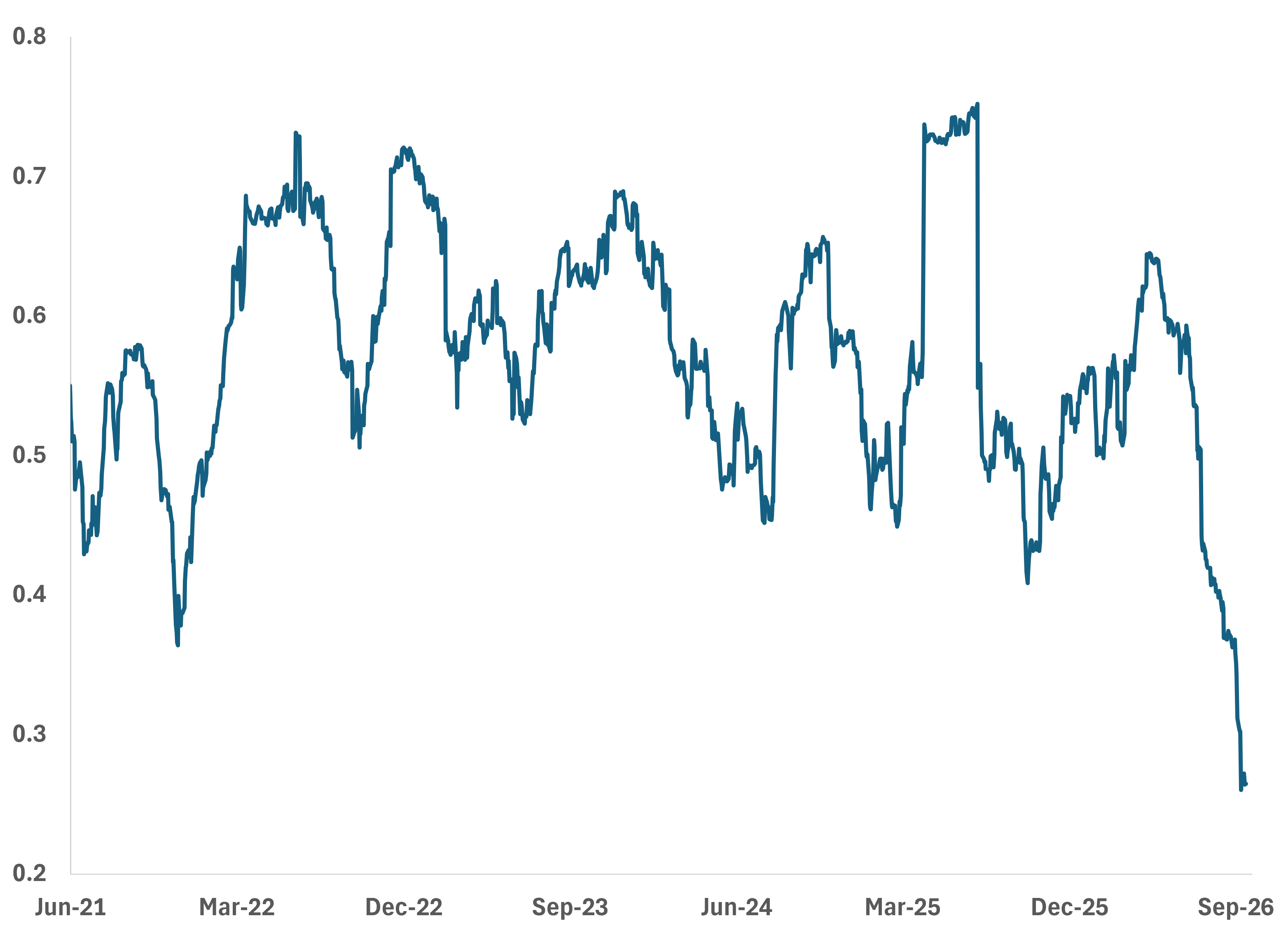
We found sentiment towards EM constructive if not excessively so, with a caveat that recent modest stock-index gains mask plenty of volatility under the surface, thus favoring nimbleness given high return dispersion and leadership rotation3 (see Figure 1). The Fed’s hike was a positive step to restore credibility, while higher long-term yields are here to stay. Questions of how to position to profit from an evolving AI landscape came up repeatedly in our talks. We unpack these subjects below:
Figure 1: Lower EM sector correlation signals widening opportunity set (average pairwise correlation, 3m rolling, MSCI EM sectors4)
AI of things. Rapid AI-led disruption remains a key investment theme, and how to position in EM to benefit from it is becoming trickier – July’s tech-centric momentum unwind a reminder of this challenge. The period of “easy” AI money is behind, one investor noted. The reason? The market’s growing questioning of the size of future AI payout and how it will be split. That is creating upside for companies that show evidence of AI-linked revenue streams and productivity gains5. Against this backdrop, valuation-based exposure may be ineffective as some names, such as “cheap” chipmakers, could keep trading at a discount6.
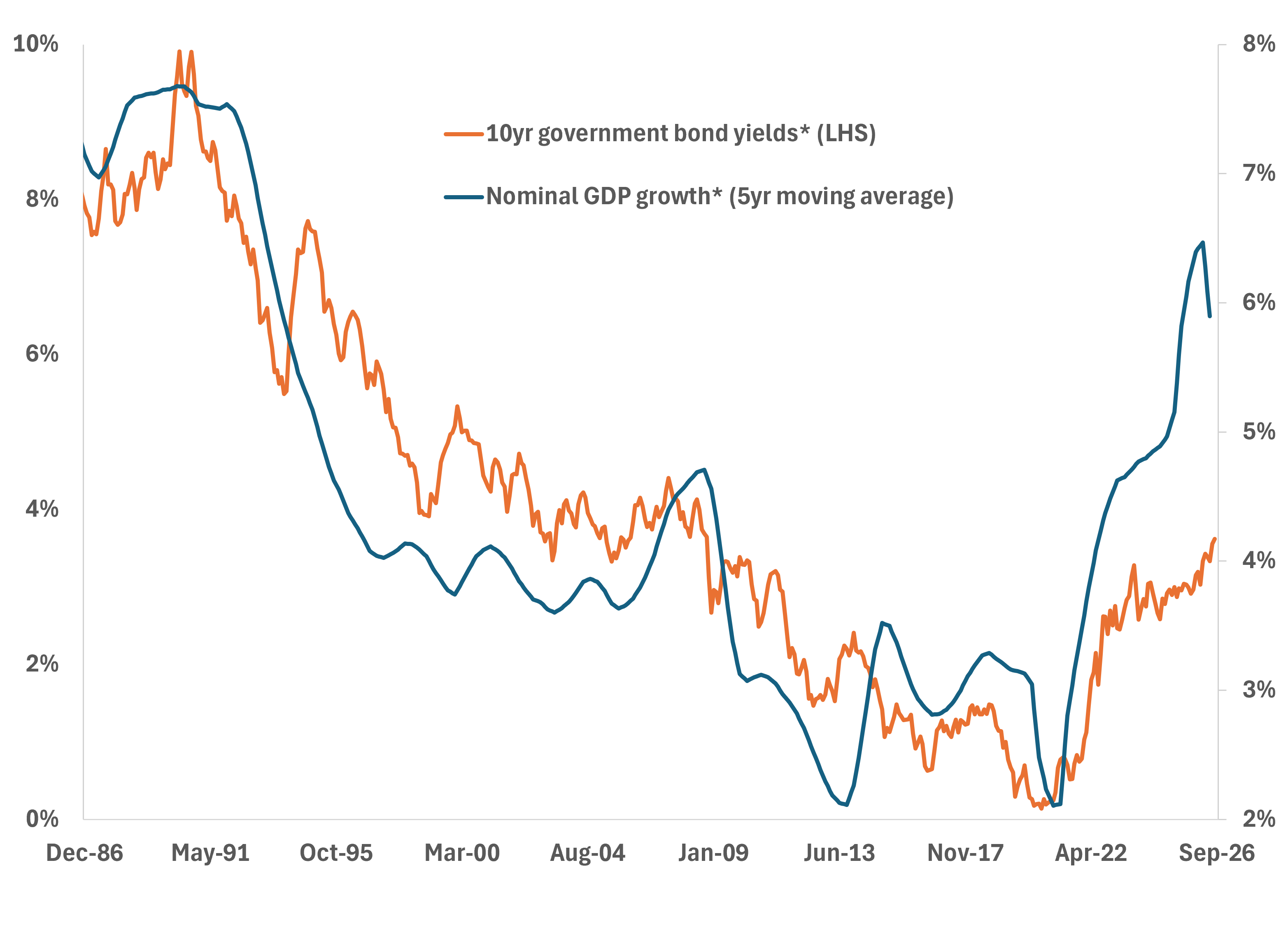
Higher for longer rates. Rising global yields were top of mind. The debate was twofold: could higher yields trigger a stock-market selloff (as in 3Q23) and what factors are driving the upward move. The more common interpretation saw high yields as a function of mostly strong nominal growth, an environment supportive of earnings7 (see Figure 2). Surging AI capex (part of the “competition for capital story” that is pressuring yields) is a tailwind for growth, with the promise of future productivity gains. Strong earnings also explain why equities are holding up despite headwinds in the form of energy and interest-rate shocks. This month’s Fed hike successfully put credibility fears to rest; with plenty seemingly in the price (3 more hikes), the risk to EM is a stronger dollar if more aggressive tightening gets priced in8.
Fiscal and inflation fears, along with uncertainty from more interventionist policies, are also at play2. Longtime EM watchers understand that fiscal issues tend to be “long term” concerns, until suddenly they can turn immediate. More generally, we found consensus on the “higher for longer” view predicated on structural factors like costs from the resiliency push (defense, energy, supply chains), no political appetite for austerity and less bond demand from price-insensitive sources like central banks9.
Figure 2: Higher-for-longer bond yields seem here to stay, whether driven by strong growth, inflation fears, fiscal concerns or else…
What’s next for EM? Stock pickers we met flagged what they saw as a healthier EM market dynamic; specifically, they welcomed the ongoing rotation from concentrated tech-led gains since the start of 2025 – Korea and Taiwan outperformed the EM index by a very wide margin – to a broader opportunity set. An aspect in this story may be that typical EM fault lines like weak fiscals and unpredictable policies are becoming DM challenges, thus weakening the case to penalize EM10. Looking further out, a common debate was how to rethink asset allocation in a world where DM bonds seem to be becoming a weaker “risk-free” ballast for portfolio diversification.
ABOUT TRG
Founded in 2002, The Rohatyn Group (TRG) is a global asset manager focused on emerging markets and real assets. Headquartered in New York the firm is comprised of ~100 professionals based in 14 countries across North and South America, Europe, the Middle East, Africa, India, Southeast Asia, and Oceania.
TRG investment capabilities span private and public asset classes focused on emerging markets as well of global forestry and agriculture investments. At the core of our business, we are dedicated to providing specialized investment solutions. Leveraging our global-meets-local approach, on-the-ground coverage, and extensive multidisciplinary investing experience we work strategically to address our clients’ unique needs.
Learn more at: https://www.rohatyngroup.com/
IMPORTANT INFORMATION – REFERENCES
1 Janus Henderson Investors. (August 4, 2026). Market moves & themes that mattered: July 2026.
2 The Economist. (September 16, 2026). Soaring bond yields, gaping deficits and towering debts: what could go wrong?.
3 Citadel Securities. (August 3, 2026). Global Market Intelligence: August – After the Reset.
4 Calculations based on 11 sectors comprising the MSCI EM Mid & Large Cap index (total return in USD)
5 SCMP. (September 21, 2026). Asia investors demand AI revenue proof as focus shifts from exposure to earnings: BofA.
6 Harvard Business Review. (September 11, 2026). The Questions you Should be Asking About the AI Bubble.
7 Morgan Stanley. (September 16, 2026). Can Stocks Keep Defying Higher Rates?.
8 Barron’s. (September 18, 2026). The Market See Rates Going Higher than the Fed Does.
9 PIMCO. (June 10, 2026). Secular Outlook: Rupture and Resilience.
10 Haroon Mumtaz and Franz U. Ruch. (October 15, 2025). Policy Uncertainty and Aggregate Fluctuations: Evidence from Emerging and Developed Economies.
IMPORTANT INFORMATION – DISCLAIMERS
The information provided herein is for educational and informational purposes only, and neither The Rohatyn Group nor any of its affiliates (together, “TRG”) is offering any product or service hereby. The information provided herein is not a recommendation, offer, or solicitation of an offer to buy or sell any security, commodity, or derivative, nor is it a recommendation to adopt any investment strategy or otherwise to be construed as investment advice. Any projections, market outlooks, investment outlooks or estimates included herein are forward-looking statements, are based upon certain assumptions, and should not be construed as an indication that certain circumstances or events will actually occur. Other circumstances or events that were not anticipated or considered may occur and may lead to materially different outcomes. The information provided herein should not be used as the basis for making any investment decision.
Unless otherwise noted, the views expressed in the content herein reflect those of the authors set forth and are not necessarily the views of TRG. In fact, the views of TRG (and other asset managers) may diverge significantly from certain of the views expressed in the content herein. The views expressed in the content herein are subject to change without notice, and TRG disclaims any responsibility to furnish updated information in the event of any such change in views. Certain information contained herein has been obtained from third-party sources. While TRG deems such sources to be reliable, TRG cannot and does not warrant the information to be accurate, complete or timely, and TRG disclaims any responsibility for any loss or damage arising from reliance upon such third-party information or any other content provided herein.
Exposure to emerging markets generally entails greater risks and higher volatility than exposure to well-developed markets, including significant legal, economic and political risks. The prices of emerging market exchange rates, securities and other assets are often highly volatile and movements in such prices are influenced by, among other things, interest rates, changing market supply and demand, external market forces (particularly in relation to major trading partners), trade, fiscal and monetary programs, policies of governments and international political and economic events and policies. All investments entail risks, including possible loss of principal. Past performance is not necessarily indicative of future performance.
The information provided herein is neither tax nor legal advice. You must consult with your own tax and legal advisors regarding your particular circumstance.