

When describing his framework to understanding Brazil’s political economy, a well-known Wall Street economist once likened the country to the “best C student” in the class, a reference to Brazil’s ability to muddle through. When facing adverse circumstances, policymakers tend to deliver sufficient adjustments to avoid earning a “failing grade.” Yet efforts to tackle long-standing challenges holding the economy back, such as weak fiscal dynamics or low productivity, usually came short of what was needed to achieve a sustainable solution1.
Assets rallied sharply after the early October vote, in which right-of-center parties made surprising gains2. The results raised prospects that Brazil would be next in line to join the region’s rightward shift, bringing with it more orthodox, business-friendly policies and closer alignment with the US. Online odds put the candidate of the right, Flavio Bolsonaro, as the favorite to win the October 25 presidential runoff3. If that result holds, will the next administration break the “best C student” pattern and validate the current wave of optimism? While the answer ultimately depends on a credible policy shift and reform delivery, we offer three quick observations that lead us to believe that part of the optimism seems justified:
Political realignment. Voters handed a strong congressional mandate to the right4. Bolsonaro’s party, the PL, will have the largest representation in both chambers in over three decades. With support from like-minded parties, if elected Bolsonaro will have an easier route to advance legislation requiring simple majorities. That opens a window of opportunity to push through changes that has been absent in prior terms, when the executive had to negotiate with the Centrão group of centrist parties, usually demanding spending pledges in exchange5.
Another important takeaway is that Brazilian politics may be entering a period of narrower set of outcomes away from the far left. One reason is that President Lula did not prepare a path towards succession, which points to a rebuilding phase until his PT party can return as a dominant force in Brazil politics6. By contrast, the center and right have experienced, known options who could have already been viable presidential candidates in 2026 (such as Governors Tarcisio and Zema).
The fiscal challenge. Unsustainable fiscal dynamics, and the resulting high real rates and low investment, represents Brazil’s top macro challenge1 (see Figure 1). While comprehensive tax or pension reforms could be game changers, we think that simply reversing the high spending growth of the past couple of years would go a long way in signaling to markets that there is a path towards fiscal stabilization. In other words, a fiscal adjustment does not have to be large or front-loaded as long as it successfully delivers a “credibility shock” that anchors expectations, opening the door for lower interest rates. Fiscal retrenchment would hit an already slowing economy, thus the importance of convincing markets that a credible policy pivot is in place that seeks to gradually address the fiscal challenge.
Spending rigidities make the belt-tightening task challenging (near 90% of spending is mandatory5) . Still, policymakers can rely on phasing out exceptions and credits (so-called tax expenditures) that the IMF estimates amount to as much as 5% of GDP, among other measures such as rethinking minimum wage adjustments1. And any spending restraint would come from a bloated base: federal outlays jumped 5.7% in real terms in January-August, nearly three times faster than expected GDP growth1,7.
AI diversification play? EM indices are increasingly technology centric and concentrated in names highly levered to the AI theme. In September, technology alone was 44% of the EM index, with the top three chipmakers representing 29%8. This high concentration coincides with the AI theme becoming more uncertain as investors question the payoff from rising capex and relative winners from AI disruption, extending recently to fears over the cost and availability of capital to fund the AI buildup9.
Against this backdrop, Brazil offers a compelling diversifier with limited direct linkages to the AI theme, ample liquidity and exposure to commodities. There is also potential upside to local factors such as a rate-compression trend and light positioning in equities by domestic retail and institutional investors who have favored fixed income after years of very high real rates. While Brazil would not be immune to an AI-linked global growth scare, it ranks high within EM in terms of providing idiosyncratic optionality from prospects of credible fiscal progress and a broader policy pivot.
Figure 1: Will the next administration manage to stabilize Brazil’s rising public debt? (Net public sector debt and real rates*)
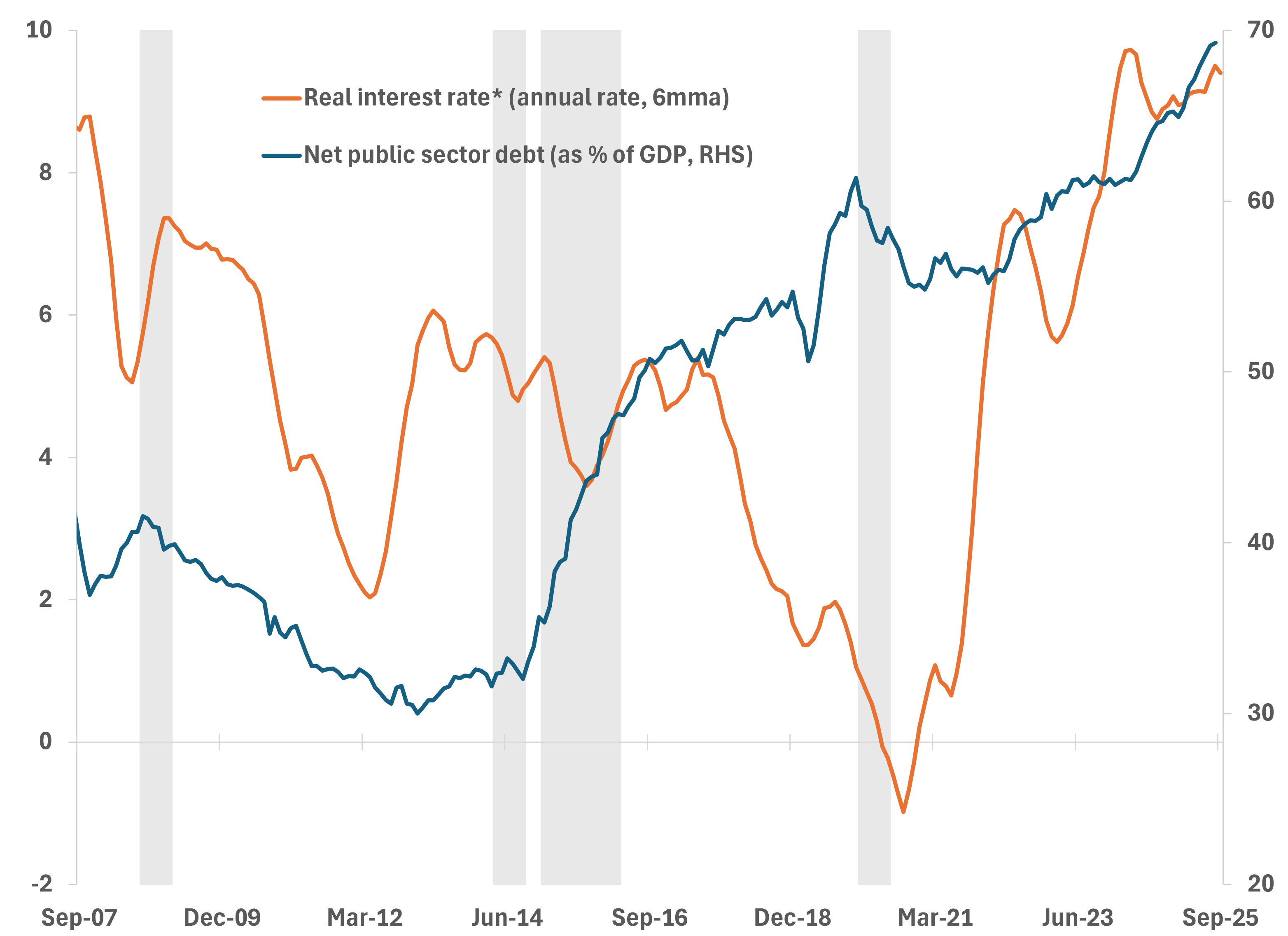
Source: BCB. Data as of October 20, 2026. *2yr government bond yield deflated by 12m trailing IPCA inflation. Shaded areas indicate technical recessions
ABOUT TRG
Founded in 2002, The Rohatyn Group (TRG) is a global asset manager focused on emerging markets and real assets. Headquartered in New York the firm is comprised of ~100 professionals based in 14 countries across North and South America, Europe, the Middle East, Africa, India, Southeast Asia, and Oceania.
TRG investment capabilities span private and public asset classes focused on emerging markets as well of global forestry and agriculture investments. At the core of our business, we are dedicated to providing specialized investment solutions. Leveraging our global-meets-local approach, on-the-ground coverage, and extensive multidisciplinary investing experience we work strategically to address our clients’ unique needs.
Learn more at: https://www.rohatyngroup.com/
IMPORTANT INFORMATION – REFERENCES
1 International Monetary Fund. (July 23, 2026). Brazil: Article IV Consultation.
2 Reuters. (October 5, 2026). Brazil markets' Bolsonaro rally sends stock exchange to record high.
3 Buenos Aires Times. (October 17, 2026). Brazil's right embraces election betting odds amid polls skepticism.
4 Reuters. (October 5, 2026). Right-wing wave in Brazil's Congress boosts Bolsonaro camp ahead of presidential runoff.
5 The Economist. (August 16, 2026). The big democracy where lawmakers are mightier than the executive.
6 Atlas Institute for International Affairs. (June 27, 2026). Brazil Without a Successor: The Failure of the Left and Implications For Regional Stability.
7 Banco Central do Brasil. (October 16, 2026). Focus Survey – Market Expectations.
8 MSCI. (September 30, 2026). MSCI Emerging Markets Index (USD) Factsheet.
9 Bloomberg. (October 19, 2026). Where to Shelter as AI Fears Rattle Markets.
IMPORTANT INFORMATION – DISCLAIMERS
The information provided herein is for educational and informational purposes only, and neither The Rohatyn Group nor any of its affiliates (together, “TRG”) is offering any product or service hereby. The information provided herein is not a recommendation, offer, or solicitation of an offer to buy or sell any security, commodity, or derivative, nor is it a recommendation to adopt any investment strategy or otherwise to be construed as investment advice. Any projections, market outlooks, investment outlooks or estimates included herein are forward-looking statements, are based upon certain assumptions, and should not be construed as an indication that certain circumstances or events will actually occur. Other circumstances or events that were not anticipated or considered may occur and may lead to materially different outcomes. The information provided herein should not be used as the basis for making any investment decision.
Unless otherwise noted, the views expressed in the content herein reflect those of the authors set forth and are not necessarily the views of TRG. In fact, the views of TRG (and other asset managers) may diverge significantly from certain of the views expressed in the content herein. The views expressed in the content herein are subject to change without notice, and TRG disclaims any responsibility to furnish updated information in the event of any such change in views. Certain information contained herein has been obtained from third-party sources. While TRG deems such sources to be reliable, TRG cannot and does not warrant the information to be accurate, complete or timely, and TRG disclaims any responsibility for any loss or damage arising from reliance upon such third-party information or any other content provided herein.
Exposure to emerging markets generally entails greater risks and higher volatility than exposure to well-developed markets, including significant legal, economic and political risks. The prices of emerging market exchange rates, securities and other assets are often highly volatile and movements in such prices are influenced by, among other things, interest rates, changing market supply and demand, external market forces (particularly in relation to major trading partners), trade, fiscal and monetary programs, policies of governments and international political and economic events and policies. All investments entail risks, including possible loss of principal. Past performance is not necessarily indicative of future performance.
The information provided herein is neither tax nor legal advice. You must consult with your own tax and legal advisors regarding your particular circumstance.